


The righthand equality follows from Euler's Theorem:

Comparing the expressions for  and
and  , we notice that
they differ only by the sign of the imaginary part of the integrand. Since for a
given complex number r = a + bi,
, we notice that
they differ only by the sign of the imaginary part of the integrand. Since for a
given complex number r = a + bi,  , we can conclude that
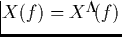 .
.
The righthand equality follows from Euler's Theorem:

Comparing the expressions for  and
and  , we notice that
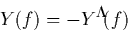
the latter is the negative of the complex conjugate of the former; that is,
, we notice that
the latter is the negative of the complex conjugate of the former; that is,
h(t) = he(t) + ho(t)
where![\begin{displaymath}
h_{e}(t) = \frac{1}{2}[h(t) + h(-t)]
\end{displaymath}](img10.gif)
![\begin{displaymath}
h_{o}(t) = \frac{1}{2}[h(t) - h(-t)]
\end{displaymath}](img11.gif)
![\begin{displaymath}
h_{e}(-t)= \frac{1}{2}[h(-t) + h(t)]
\end{displaymath}](img12.gif)
Applying the commutative property of addition gives
![\begin{displaymath}
h_{e}(-t)=\frac{1}{2}[h(t) + h(-t)] = h_{e}(t)
\end{displaymath}](img13.gif)
Similarly, to show that ho(t) is odd, we must demonstrate that ho(-t) = -ho(t). Substituting -t for t in the expression for ho(t) gives
Hence, ho(t) is an odd function.
Finally, to establish that h(t)=he(t) + ho(t), we simply add the expressions for he(t) and ho(t) and perform some algebra.


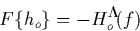
Recalling the result from part b) that the Fourier transform of an odd function is the negative complex conjugate of the Fourier transform of that function, we can express the Fourier transform of the odd part of h(t) as follows:
 of width one and height
one. To validate the results from parts e) and d), we must rewrite h(t) as the
sum of even and odd parts, find the respective Fourier transforms, and take the
superposition of the two transforms.
of width one and height
one. To validate the results from parts e) and d), we must rewrite h(t) as the
sum of even and odd parts, find the respective Fourier transforms, and take the
superposition of the two transforms.
The Fourier transform of a pulse of height and width one centered around
 is given by

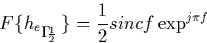
The even part of h(t) is given by
![\begin{displaymath}
h_{e}(t) = \frac{1}{2}[h(t) + h(-t)]
\end{displaymath}](img20.gif)
 of width one
and height
of width one
and height  , along with its reflection across the y-axis.
Applying superposition, we can find the Fourier transform of the sum of these
two pulses by adding the Fourier transforms of the individual pulses. For the
pulse component centered around  ,
,

 ,
,
The odd part of h(t) is given by
![\begin{displaymath}
h_{o}(t) = \frac{1}{2}[h(t) - h(-t)]
\end{displaymath}](img27.gif)
 of width one
and height
of width one
and height  , in addition to its reflection across the origin,
centered around
, in addition to its reflection across the origin,
centered around  of height
  and width one. Using the
same procedure as with the even part of h(t), we can find
and width one. Using the
same procedure as with the even part of h(t), we can find  by
taking the superposition of the separate pulses comprising ho(t).
by
taking the superposition of the separate pulses comprising ho(t).
For the pulse component centered around  we have

 we have

Thus
Simplification yields

 .
.